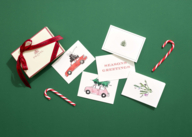
The Advent and Christmas season is a good opportunity to celebrate artisan craftspeople and makeries in and around Munich. After all, you would be hard pushed to find gifts more unique than those produced in these festive workshops. Happy gifting – and making!
- Chocolates from Elly Seidl
- Christmas post from Prantl
- Gingerbread hearts from Schifferl
- Christmas cribs from the manufactory
Barbara Grathwohl was an emancipated woman: in 1918, despite being married to a well-to-do Munich resident, she opened her own shop on Maximilianstrasse whilst in her mid-thirties. Under the name Elly Seidl – after her daughter and her maiden name – she initially sold delicatessen goods and jams, but soon began producing handmade pralines on request, which remain the confectionery’s speciality to this day.
Since the 1970s, the Rambold family has carried on this legacy and expanded the range to include chocolate bars, drinking chocolate and seasonal specialities. Particularly during Advent, they create figures made from Belgian couverture chocolate, as well as chocolate versions of Elisen gingerbread, Florentines and Baumkuchen. Customers can put together their own box of chocolates online from around 120 varieties – it is even possible to have personalised chocolates featuring their own photo.
The pralines have evocative names such as ‘Honey Moon’, with macadamia nougat and honey, or ‘Copa Cabana’, with rum and pineapple-lemon paste; prominent Munich residents such as Willy Bogner, Konstantin Wecker and Dieter Reiter also have their own varieties. According to legend, the history of the praline itself dates back to the 19th century, when the Swiss chocolatier Frédéric Neuhaus used chocolate in Brussels to refine confectionery.
Insider tip: Elly Seidl recommends savouring her pralines slowly and consciously savouring the flavours – after all, almost half a year of development goes into each new variety, and one was even named after Emma, the daughter of Maximilian Rambold.
Where to find it? Elly Seidl, Maffeistraße 1 / Am Kosttor 2 / Tal 40
Also great: Götterspeise
“On the sheet in question from Mr Prantl’s stationery shop [...] I wrote *Der Krull*,” Thomas Mann noted in his diary. The writer was fond of the paper produced by the Munich-based court printing house and manufacturer of fine goods, Prantl, on which many of his works were written. The family business was founded in 1797 by Franz Anton Prantl and is today one of the oldest of its kind in the world.
Prantl specialised in fine stationery, bespoke printed matter and special paper finishes. One of its specialities was steel-engraved embossing, which engravers used to produce coats of arms, initials and monograms for kings, nobles and prominent figures. Even today, Prantl remains synonymous with high-quality paper and the special art of writing.
Today, the Munich store in the Luitpoldblock stocks not only fine stationery but also notebooks, writing instruments, leather accessories and unique gift ideas. At Christmas time, the range is expanded to include Prantl’s own collection of festive cards – from classic designs to Bavarian Christmas motifs and cards that can be personalised.
Insider tip: Prantl has always specialised in personalisation. Today, you can print your own designs, photos and drawings onto stationery and cards online and have them delivered in the iconic red gift box. Alternatively, there’s also bespoke stationery available from Prantl’s typesetting department.
Where to find it? Prantl, Brienner Str. 11, and at Ludwig Beck ‘Papeterie’, Marienplatz 11
Also great: Carta Pura
As far back as 1370, the city of Munich has been cheered by the spiced honey cookies offered by a “Lebzelter”, or gingerbread maker. Unlike in Nuremberg, where the cakes were decorated with almonds and candied lemon peel, the Munich bakers used cutters to cut the biscuits into shapes and decorated them with colourful icing. To this day, the gingerbread heart is key to the city’s image as the “metropolis with heart”.
You will see the tasty treats swinging from many stands at large and small Munich folk festivals and Christmas markets throughout the year. “People use our hearts to send messages,” says Michael Schifferl, who has been making lebkuchen at his bakery in Puchheim since 1979 and inscribes each one individually – with pet names, phone numbers and even a marriage proposal on one occasion! Munich mainstay chef Alfons Schuhbeck enjoys gifting the hearts to his co-workers. Schlager group The Flippers told their fans: “You are the Oscar of my heart”.
Though markets are on hold for the moment, you don’t have to forgo your lebkuchen: hearts, Christmas figures from reindeer to stars and gender-neutral gingerbread people are all available to purchase online from Schifferl – inscribed and shaped as you wish. Alternatively, you can order blank gingerbread shapes to add your own message and then hang them around your neck or on the Christmas tree. Perfect for wishing your granny “Merry Christmas and a happy New Year”, surprising colleagues, or letting your best friend know that this year's German youth word of the year is “lost” (which means “I don't get it”). Or even simply for saying “thank you”.
Insider tip: Gingerbread stays fresh for at least two years. Mind you, that’s the minimum. Even the ancient Egyptians used to place honey-sweetened cakes in their dead people’s tombs for the afterlife. We place them under the Christmas tree for our loved ones.
Where to find it? In the online shop of Lebkuchenherz München Schifferl
Also great: Lebkuchen Schmidt
Nativity scenes are among the oldest Christmas traditions and were the centrepiece of the festivities for a long time before the Christmas tree became popular in the 19th century. As early as 1223, Saint Francis of Assisi had the Christmas story re-enacted with people and live animals in Greccio, Italy – a tradition that continues to shape the anticipation of Christmas Eve to this day.
In a joinery workshop in Herbertshausen near Munich, David Seifert and Thomas Babinsky have discovered their shared passion for nativity scene-making. Alongside their work with local woods, they create intricately detailed Oriental and Alpine nativity scenes that effortlessly transplant the birth of Christ from Bethlehem to Bavaria. With mini ladders, outhouses, bread ovens and many other details, these little scenes tell their very own stories.
If you’d like to build your own nativity scene, you’ll find detailed online guides on construction, painting, lighting and design. An even more practical option is a nativity scene-building course run by the Ampertaler Krippenfreunde, which takes place every year from September to November. This way, the nativity scene becomes not just a decoration, but a piece of homemade tradition. Further information on the courses is available at www.ampertaler-krippenfreunde.de.
Insider tip: Mary is kneeling or standing to the right of the Baby Jesus in the manger, on the Gospel side – that is, to the left as seen by the viewer. Joseph is standing on the Epistle side, that is, to the right. Whether in the stable or close to the action, the donkey stands on Mary’s side, and the ox on Joseph’s. Source: The Bible and ‘The Pseudo-Matthew Gospel’ (it really does exist).
Where to find it? Weihnachtskrippen Manufaktur, Ligsalzstraße 46, 85241 Hebertshausen (Visits by prior appointment) or via the online shop
Also great: Sebastian Wesely e.K.